Bringing in the 2018 Harvest

Elise StimacGrowing, Harvest, Wine makingLeave a Comment

Christine Stimac with 2018 harvested grapes from Three Feathers Estate & Vineyard, Willamette Valley AVA, Chehalem Mountain, Oregon.
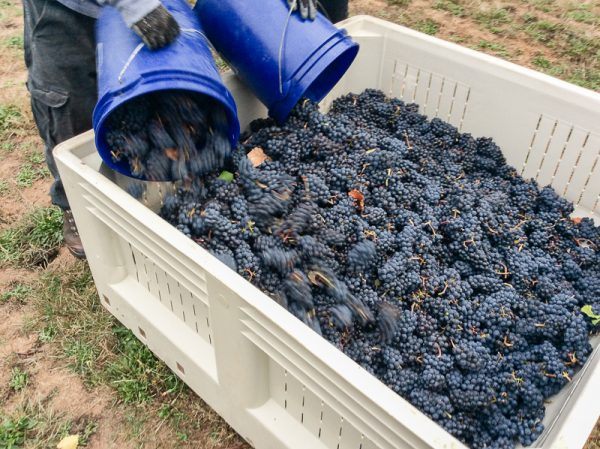
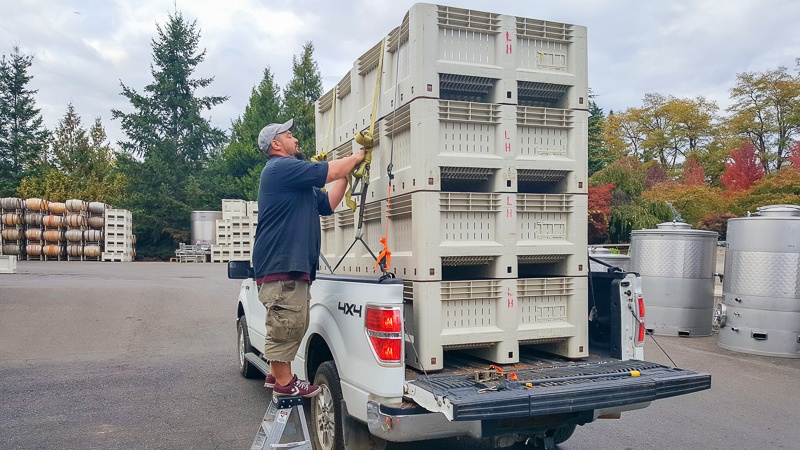
Cellar manager, Tony, unstraps bins full of Three Feathers 2018

Cellar manager, Tony, unstraps bins full of Three Feathers 2018 grapes.

Bringing in the 2018 Harvest

Choosing the best moment to harvest grapes is a delicate matter. We spent three weeks in the vineyard, three hours a day, trimming leaves away from the fruit and thinning clusters that seem to be lagging behind. We checked the sugar content (Brix) every few days to see if the fruit was at the perfect ripeness for our wine. The birds seem to know as well as our Refractometer; as soon as we reach 21 Brix, they descended to pick their fruit.

On September 12, the sugar levels in Three Feathers Vineyard were between 17.5 and 18. By September 15, we were getting readings of 21.5 but the overall vineyard sampling was only at 20.7 and 3.00 PH on September 18. Readings on September 27 were up at 24.5 Brix – a good target for picking – but acidity was still a little low at 3.10. We scheduled our picking for October 1 and prayed that acidity levels would rise.

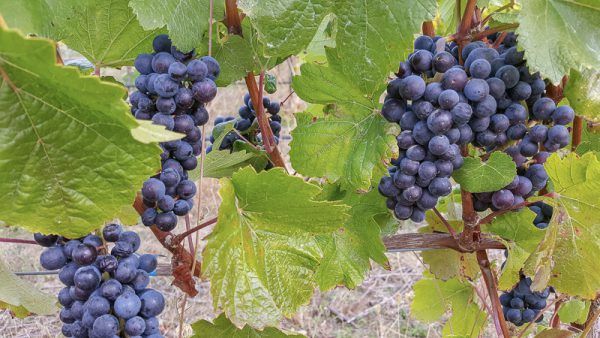
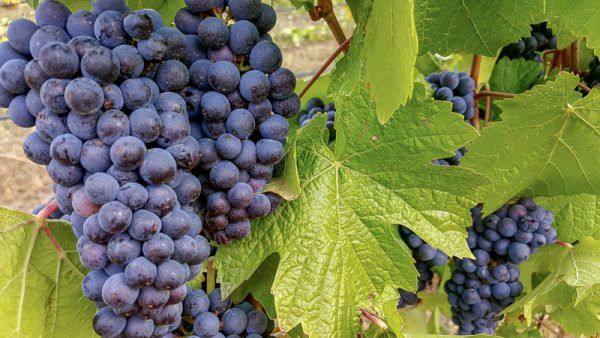
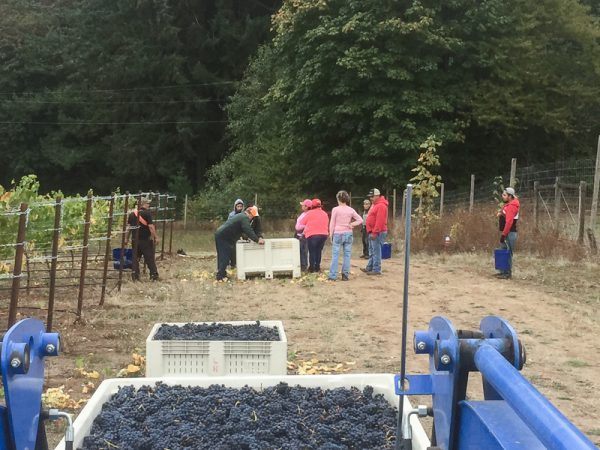
October 1 arrived and so did our crew at 7 am! We only had half the bins we needed and by 8 am they had already picked 6 tubs – approximately 1.5 tons – and no more bins! This professional crew was amazing! It would have taken us twice that time. As romantic as it is to pick grapes, it is a lot of work and these folks made it seem easy. Eventually the second truck load of bins arrived and we finished picking by 9:30 am. The total pick was 6700 lbs., or a 75% increase over last year. The fruit looks gorgeous, dark and uniform.

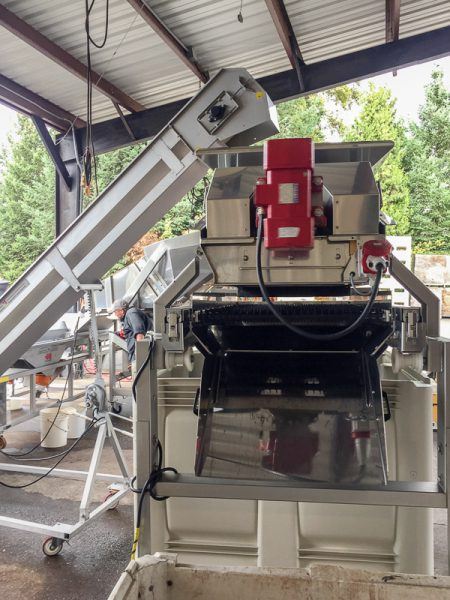
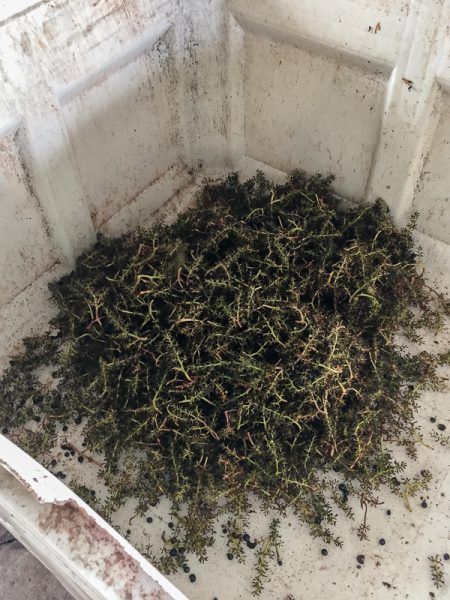
At the winery we watched the sorting and de-stemming of our harvest (watch video). Dan, our winemaker, checked the numbers and we are pleased to report a total Brix count for 2018 of 24.7 and PH of 3.25.

Christine Stimac with 2018 harvested grapes from Three Feathers

Christine Stimac with 2018 harvested grapes from Three Feathers Vineyard.

Cellar manager, Tony, and colleague hand-sorting grapes before d

Cellar manager, Tony, and colleague hand-sorting grapes before de-stemming.

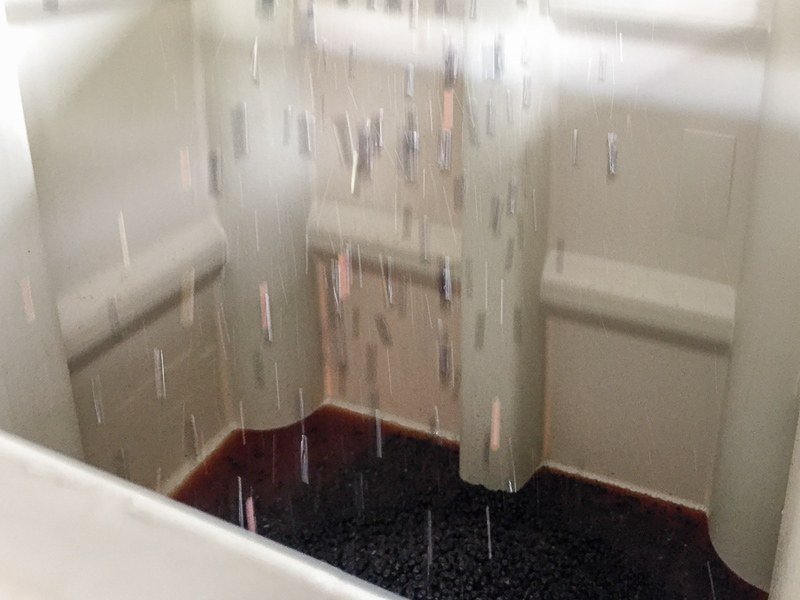
De-stemmed grapes from 2018 Three Feathers Harvest falling into

De-stemmed grapes from 2018 Three Feathers Harvest falling into bins before fermentation at Lady Hill Winery.

The 2018 growing season in Three Feathers is done and we have created another lovely wine.  Our 2018 Three Feathers Pinot Noir will be deep red and rich.  As all vintages reflect their season in the vineyard the heat and drought this year will produce a sweeter, richer, fruitier vintage and we can’t wait to try our first taste!

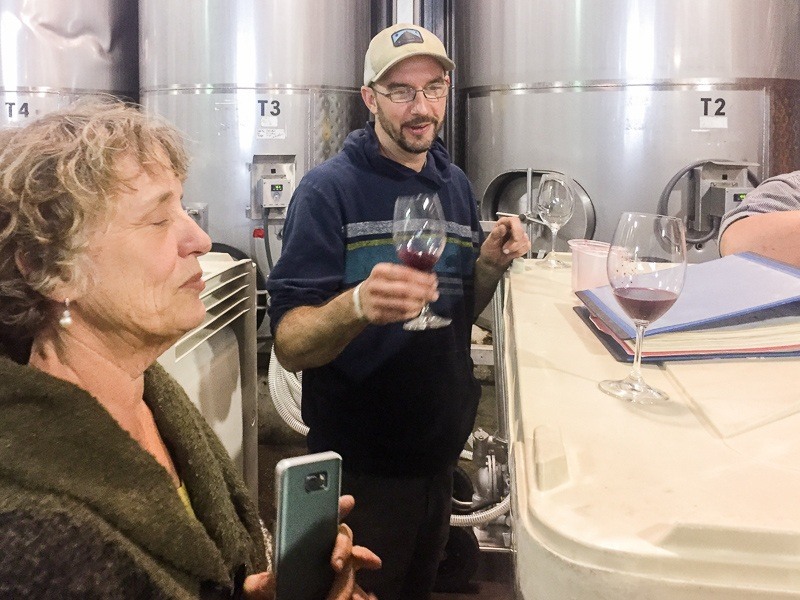
Dan Duryee and Christine Stimac at Lady HIll Winery trying our 2

Dan Duryee and Christine Stimac trying our just harvested 2018 Three Feathers Pinot Noir.

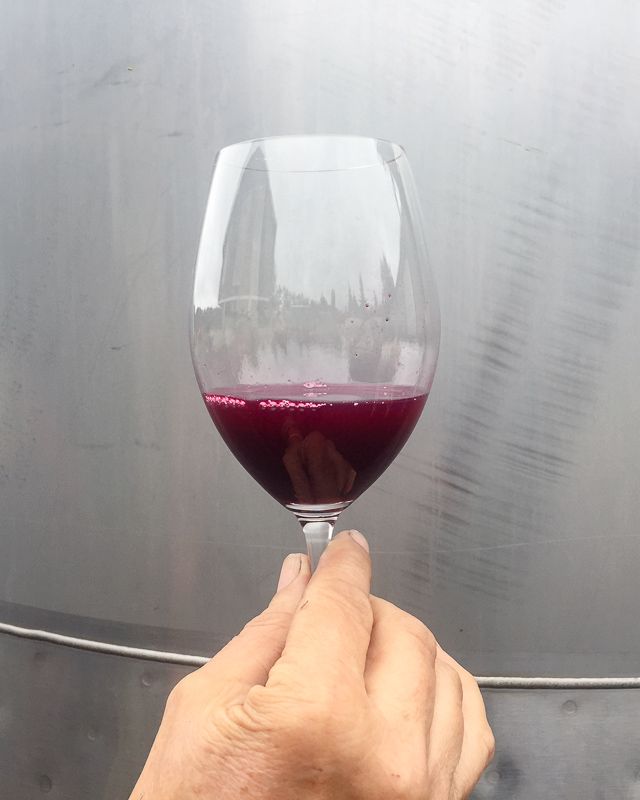
Glimpse of our just harvested 2018 Three Feathers Pinot Noir.

Glimpse of our just harvested 2018 Three Feathers Pinot Noir.

So, where are you located exactly?

Elise StimacGrowing, Locator Maps

Map indicating the sub AVA regions of the Willamette Valley, Oregon, USA.

The Big Picture

“So, where are you located exactly?” is a FAQ at Three Feathers Estate & Vineyard.  During travels within Oregon, out-of-state and overseas, we are amazed at how many people recognize the Willamette Valley as a Pinot Noir wine producing region.  Some even recognize “Willamette Valley” before they mentally locate the State of Oregon!  Explaining what an AVA is requires another few minutes and then we get into sub-AVAs and Chehalem Mountains and our listener is already lost.

Having just come across a great article Tips On Finding The Best Oregon Pinot Noir, by Madeline Puckette, complete with legible maps showing the Willamette Valley AVA and more specifically the 6 sub-regions that comprise it (Chehalem Mountains, Dundee Hills, Eola-Amity Hills, McMinnville, Ribbon Ridge, and Yamhill-Carlton) it occurs to us that we have not included a map locator on our site!

To give you the Big Picture, we include two beautifully illustrated maps of the Willamette Valley sub-AVA regions and specifically that of the Chehalem Mountains, courtesy of the Oregon Wine Board.  We are situated in the Chehalem Mountains, the northern most corner of Yamhill County, on the opposite side of the mountain from Ribbon Ridge.

Veraison Diary

Elise StimacGrowingLeave a Comment

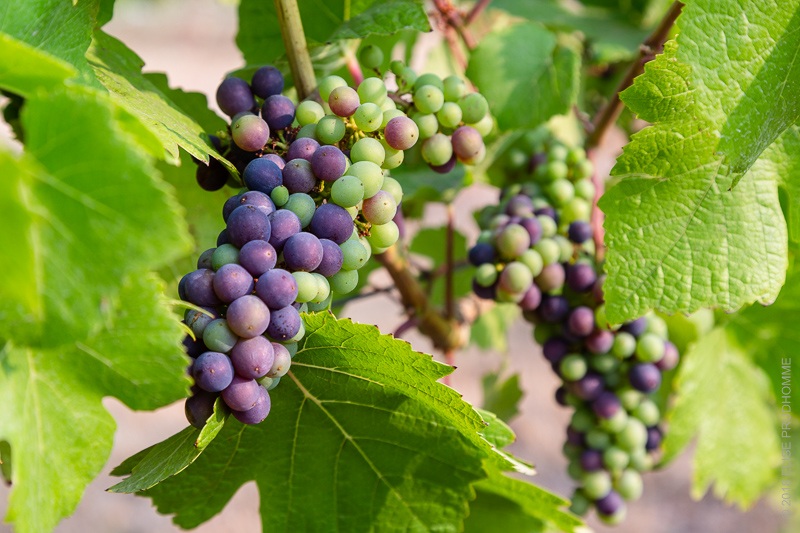
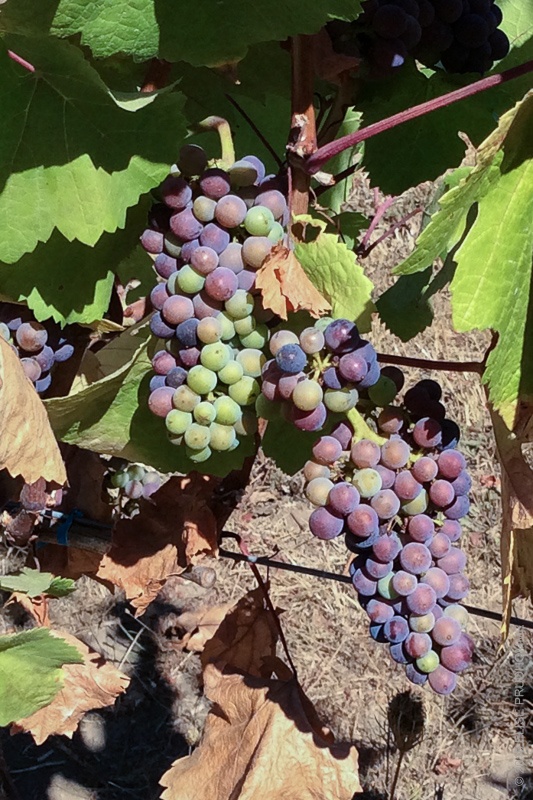
Pinot Noir grapes in the veraison process during which grapes begin to ripen growing in size, weight and sugar content, Three Feathers Estate, Chehalem Mountain AVA, Willamette Valley, Oregon.
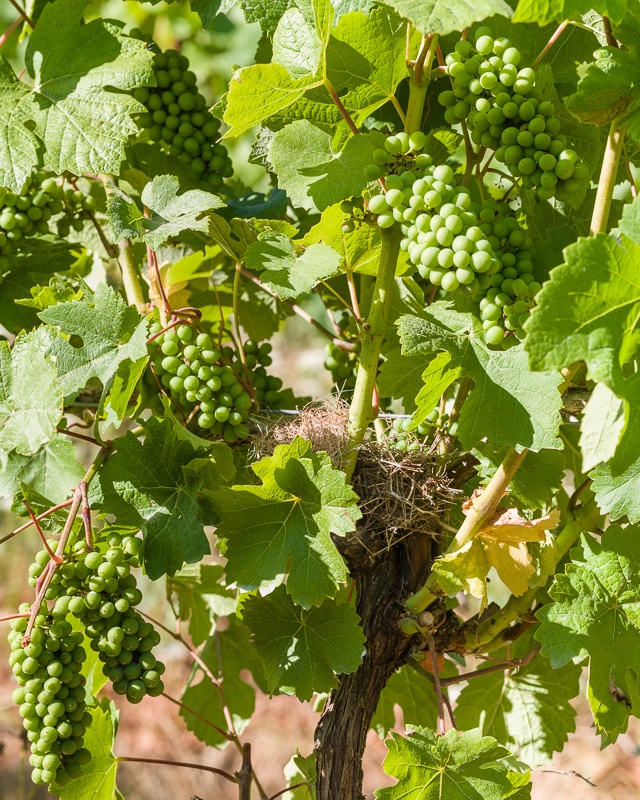
Three Feathers Pinot Noir 2017 in pre-veraison stage with bird n

Pre-Véraison.  Birdnest discoveries are becoming common on Three Feathers vineyard.

50 Shades of Purple

Véraison is a French word describing the process of ripening in grapes.  After the plants bloom, they go through a two month long period of maturation during which the plants, essentially climbing vines, put on tremendous growth of the shoots and tendrils.  Just when you are exhausted from trimming, hedging and trying to keep the vines in their trellis, an occasional purple grape appears. This is the Véraison Phase.  In a very short time, one week to ten days, the plants stop growing and the grapes start to turn color.

Once this process begins, the grapes will swell and become progressively sweeter.  Our job then is to thin any under-ripe fruit and check frequently for the sugar content required to make a desired wine.

August 15, 2018 | Véraison begins in the Precoce
Pinot Noir grapes in the veraison process at Three Feathers Esta

Pinot Noir grapes, Precoce clone, beginning the véraison process.

Pinot Noir grapes in the veraison process at Three Feathers Esta

Précoce, an early ripening Pinot Noir clone, in the véraison process.  Grapes begin to ripen growing in size, weight and sugar content.

August 25, 2018 | Véraison begins in the Pommard
Pinot Noir grapes at commencement of veraison on Three Feathers

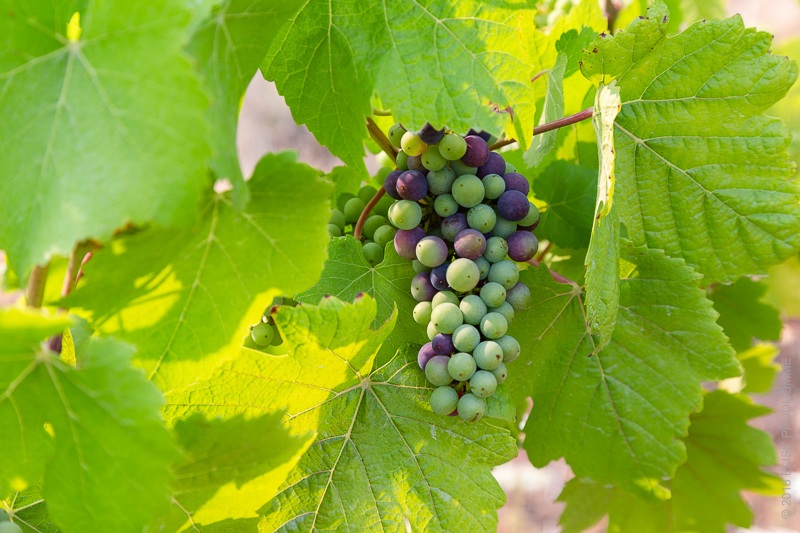
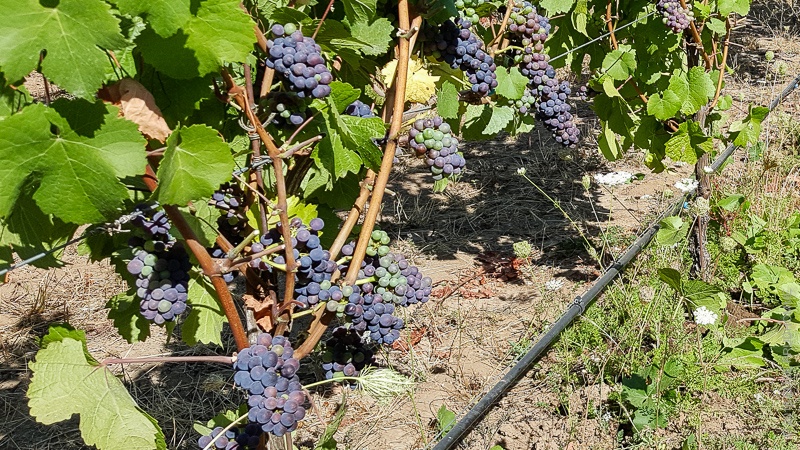
Late summer Pinot Noir grapes, Pommard clone, in veraison.

August 30, 2018 | Three Feathers Pinot Noir Dijon clone 667 trimmed for harvest
Pinot Noir grapes in middle stage of veraison on Three Feathers

Pinot Noir grapes, Dijon clone 667, in mid-stage of véraison on Three Feathers Estate, Chehalem Mountain AVA, Oregon.

September 2, 2018 | Précoce, an early ripening varietal, at a sugar count of 15-17 Brix
Pinot Noir grapes in middle stage of veraison, under bird nettin

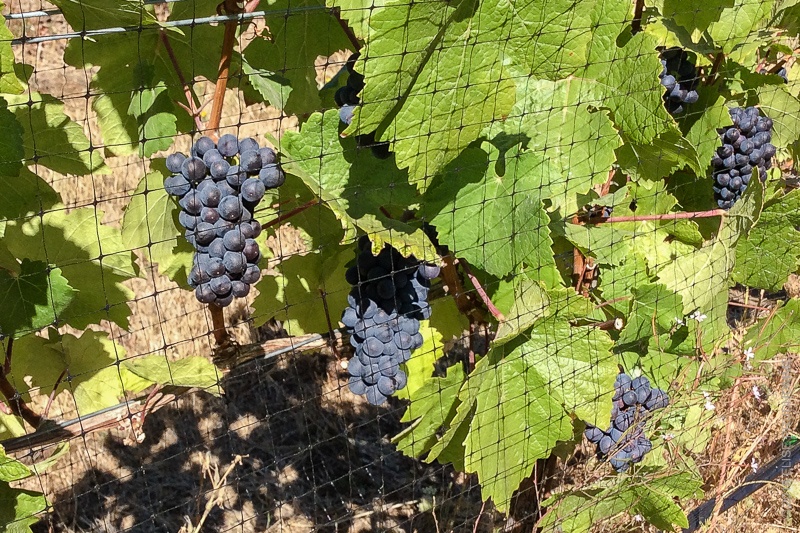
Pinot Noir grapes, Précoce clone, at 15-17 Brix on Torio Vineyard, Chehalem Mountain AVA, Oregon.

We aim for a sugar count (Brix) of 22-23.5 to produce a clean tasting wine with a good balance between sweetness and acidity.

2017 Three Feathers Wines are Here!

Elise StimacWine makingLeave a Comment

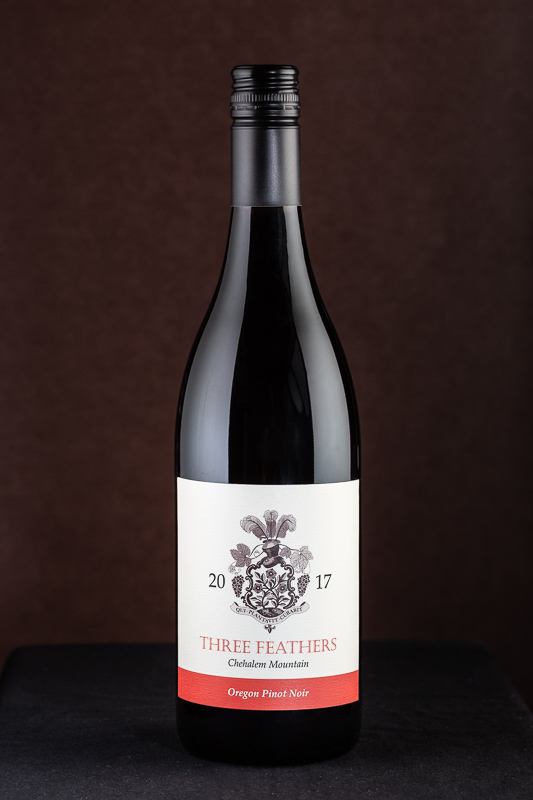
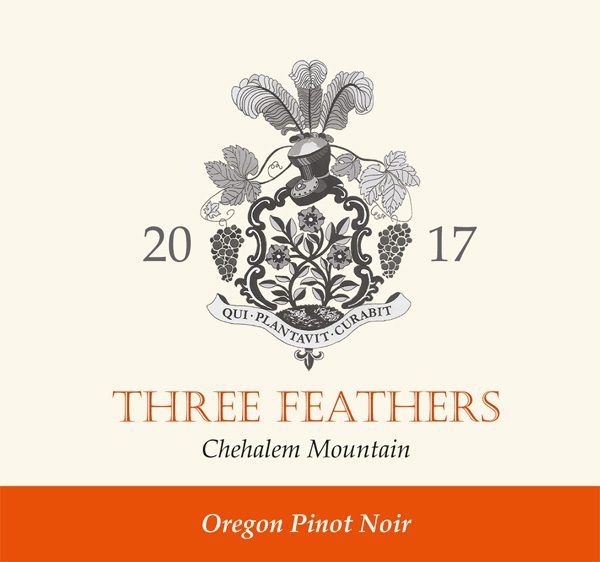
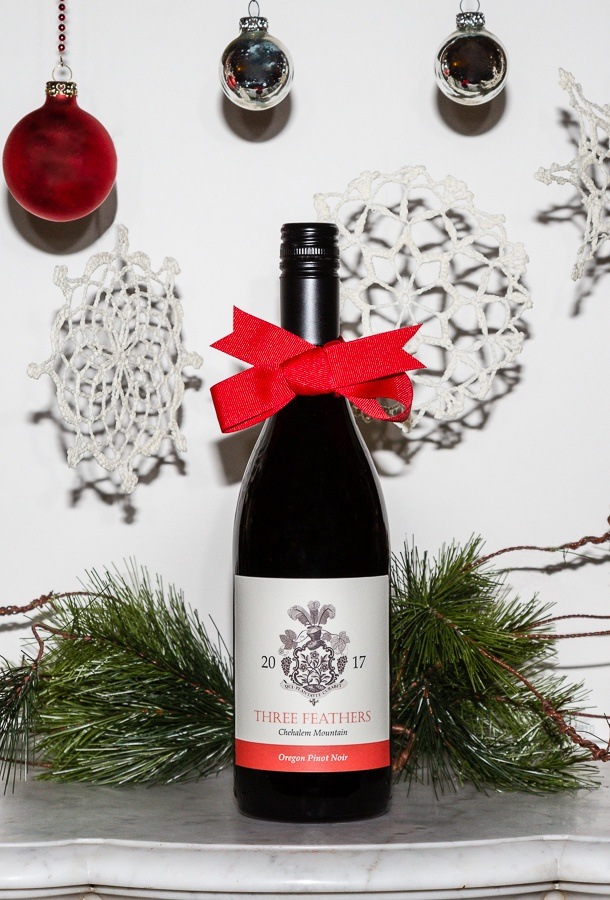
Three Feathers Pinot Noir 2017 vintage

Three Feathers Pinot Noir 2017 vintage

Presenting our 2017 Three Feathers Wines!

We are pleased to announce that our much anticipated 2017 wines have been Bottled and will Ship starting September 15.
2017 Three Feathers Pinot Noir

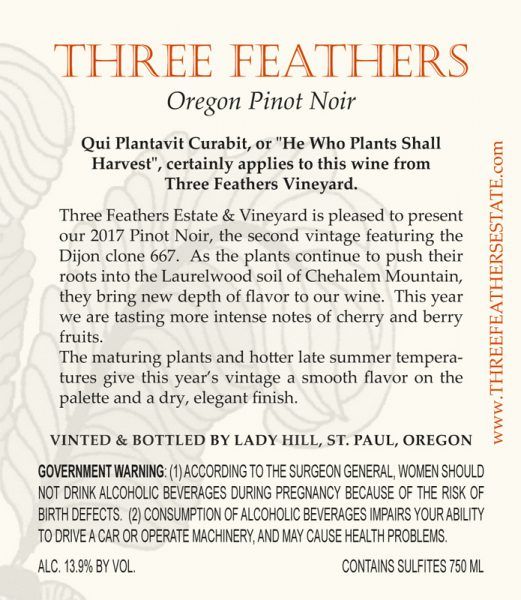
We continue to perfect our small-lot single-clone Pinot Noir from the Dijon Clone 667 grapes grown in Block One of Three Feathers Vineyard.  The complexity of this vintage is coming forth as the vines mature and their root structures dig deeper into Laurelwood soil.  This year’s wine is a ruby, garnet color with a light aroma of berry fruit and floral notes. The initial taste is slightly sweet with a tangy depth on the mid-palette and a lingering richness at the finish. We picked at a slightly higher Brix count of 23.5 and employed a new yeast this year: the combination of these factors has yielded a vintage that is fully enjoyable with or without food.

The 2017 Three Feathers Pinot Noir has an alcohol content of 13.9%. A total of 329 bottles were made.


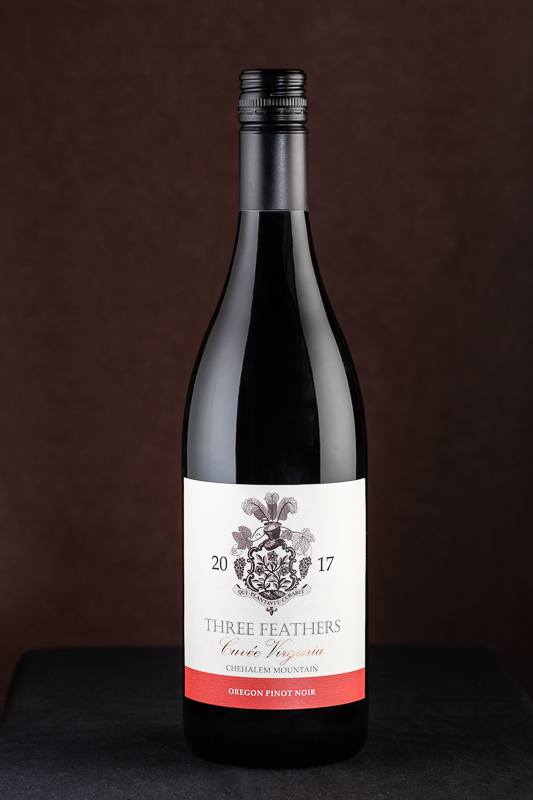
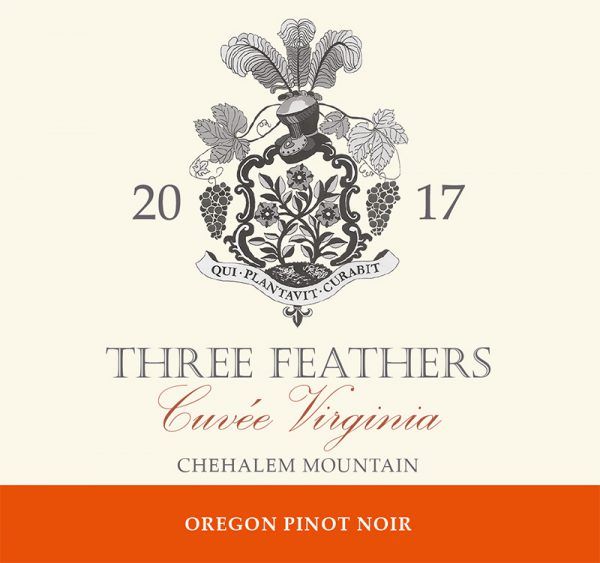
Three Feathers Cuvee Virginia Pinot Noir 2017 vintage

Three Feathers Cuvée Virginia Pinot Noir 2017 vintage

2017 Cuvée Virginia Pinot Noir

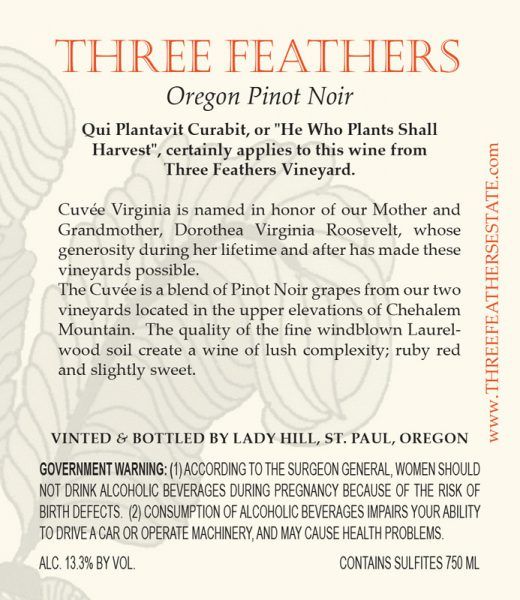
This is the debut of our Cuvée Virginia Pinot Noir, named in honor of our mother and grandmother, Virginia Roosevelt Armentrout.  We picked grapes from our two vineyards, Three Feathers Vineyard and Torio Vineyard – located only one mile apart, and combined them for a complex, luscious Pinot Noir with a deep ruby red color.  We believe we have struck the perfect balance of sweetness and acidity without being cloying or losing the delicacy of Pinot. The grapes at both sites are Pinot Noir, but we have five different clones including an early ripening clone, Precoce, that is not seen frequently in the valley. Participants at several barrel tastings were very impressed with the Cuvée Virginia.

The 2017 Cuvée Virginia Pinot Noir has an alcohol content of 13.3%. A total of 1,980 bottles were made.

Three Feathers 2017 Pinot Noir Wines are in the Bottle!

Elise StimacWine making

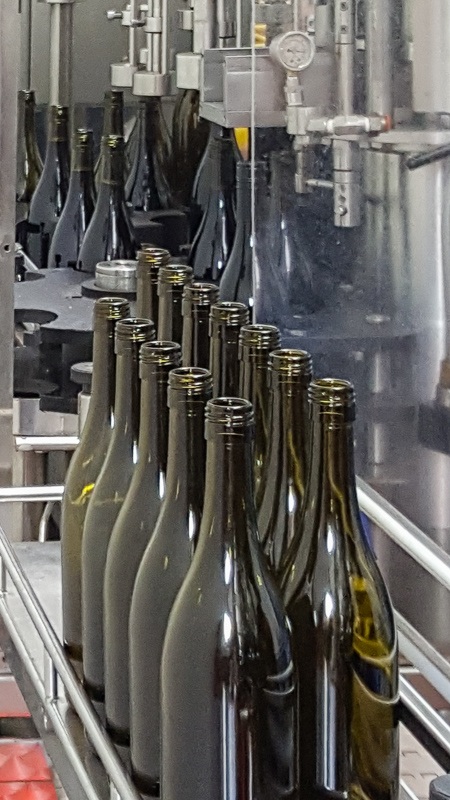
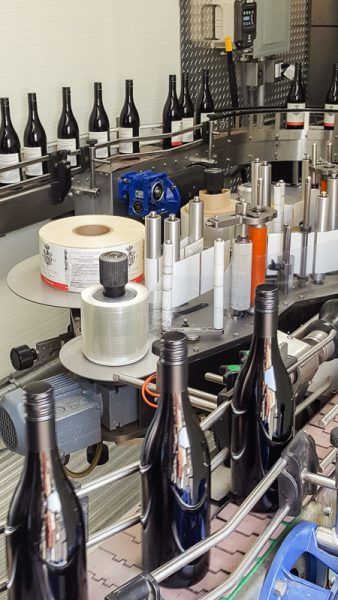
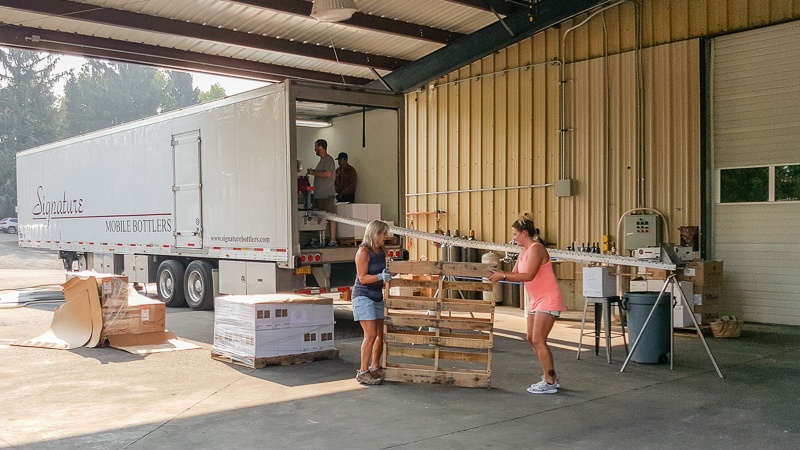
Three Feathers bottles enter the bottling process on the Signature Bottlers line-up.

Bottling 2017 Three Feathers Vineyard Wines

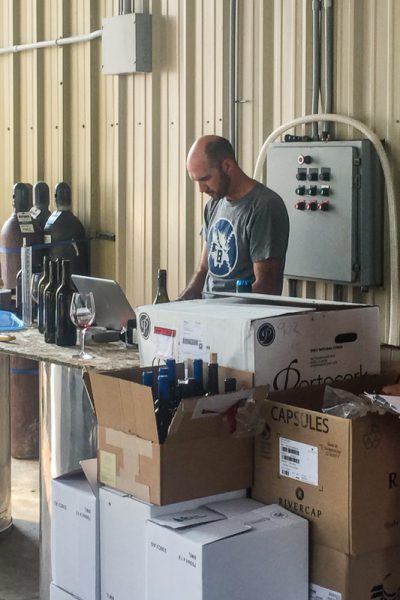
August 21,2018 was the day designated to bottle our 2017 wines that were harvested in early October; our Three Feathers Pinot Noir, and a new wine, the Cuvee Virginia Pinot Noir.

A tremendous amount of preparation goes into this moment. While the wine is resting comfortably over the winter our resident artist and photographer, Elise, is laboring to produce the perfect label to express our product. Christine is writing descriptions for the label backs. Once the label designs are finalized, they are submitted to a Federal regulating board, the TTB, to ensure that the proper government warning is correctly shown on the label and the alcohol content, upon which liquor taxes are based, is recorded.  The TTB also reviews wine label descriptions for accuracy and clarity with regards to the geographical location of the wine and its AVA.

Our labels are then sent to a well-known label printer in Portland.  Wine bottle labels are printed in one continuous roll, front to back, based on the requirements of the label machine which spins the bottles front to back for adhesion. In the meantime, Dan Duryee our winemaker at Lady Hill is busy orchestrating filtration (read our previous article Stirred, not Shaken).

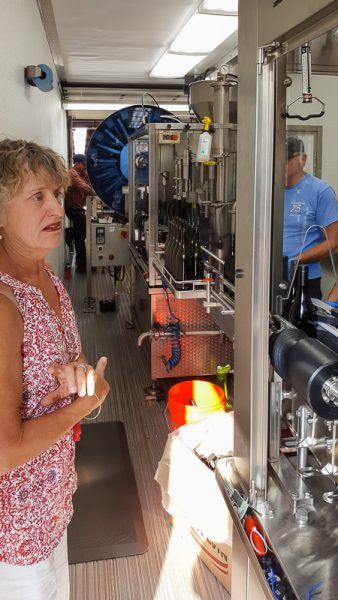
The bottling apparatus is housed in a mobile truck trailer operated by an independent company, Signature Bottlers, who service many regional wineries. The inside is a fantastic feat of engineering (see our video)!  The empty bottles are fed in one end on a conveyor belt that fills the bottles with wine pumped from the winery,  installs (in our case) the screw cap, and puts on the labels.

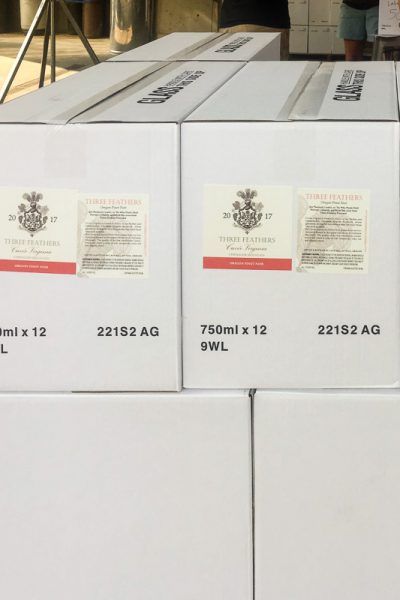
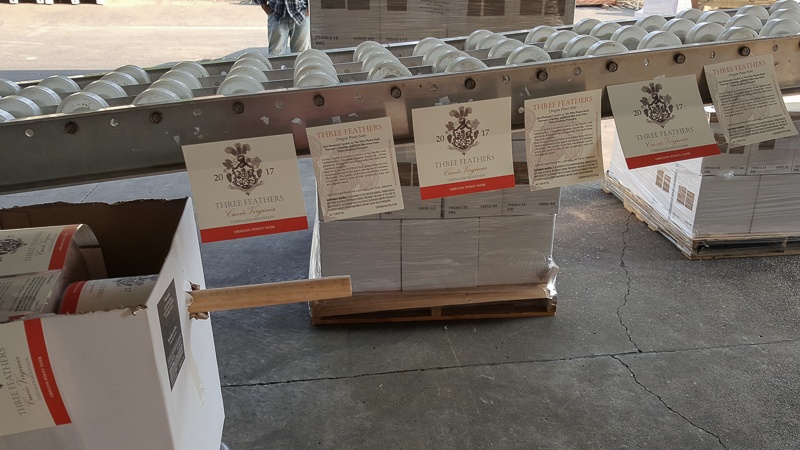
The bottles then circulate back to the beginning where human hands put them in cases.  A machine seals the case which then races down a shoot to the arms of workers below who smack a label on the case and stack them for shipment. The entire process, 2,500 bottles for Three Feathers Vineyard, took about an hour!

Packaged cartons of Three Feathers wine exit the Signature Bottl

Packaged cartons of Three Feathers wine exit the Signature Bottlers truck at full speed and roll on down for labeling and delivery.

Overview of bottling process and Signature Bottlers assembly tru

Overview of bottling process and Signature Bottlers assembly truck at Lady Hill Winery.

Pan Bagnat, Two Versions

Elise StimacPairing, RecipesLeave a Comment

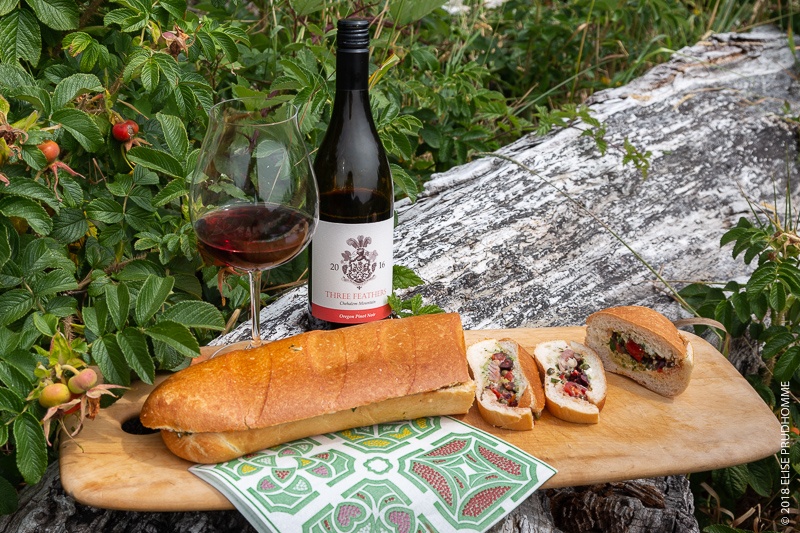
Picnic on the Oregon Coast with a Pan Bagnat sandwich and a bottle of 2016 Three Feathers Pinot Noir.  The 'Pan Bagnat' is a traditional local sandwich NICE Alpes-Maritimes French Riviera Provence-Alpes-Côte d'Azur France.
Pan Bagnat sandwich and Three Feathers Pinot Noir

Picnic on the Oregon Coast with a Pan Bagnat sandwich and a bottle of 2016 Three Feathers Pinot Noir.
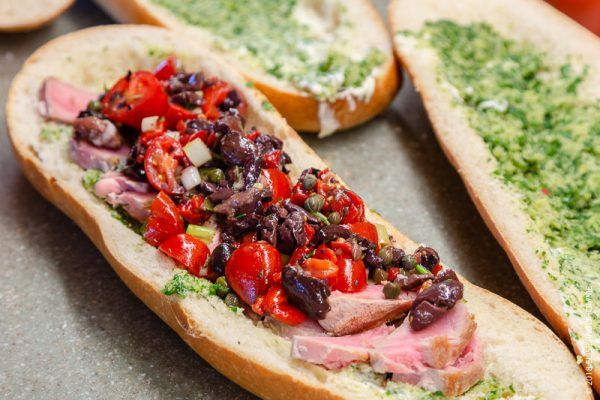
Pan Bagnat, literally Bathed Bread, is a sandwich originating from the French region of Provence which is very popular in Nice. The bagnat is a round crusty bread that absorbs juices without falling apart. The interior of the loaf is removed and filled with a variety of ingredients such as an anchovy-based vegetable salad with hard boiled eggs known as Salad Niçoise.  We have encountered several versions of Pan Bagnat designed for all tastes and propose two versions in this article using a popular Pacific Northwest ingredient, Ahi Tuna.

Our Three Feathers Pinot Noir pairs exceptionally well with this hearty French sandwich, perfect for picnics along the Oregon Coast!

Pan Bagnat, Two Versions
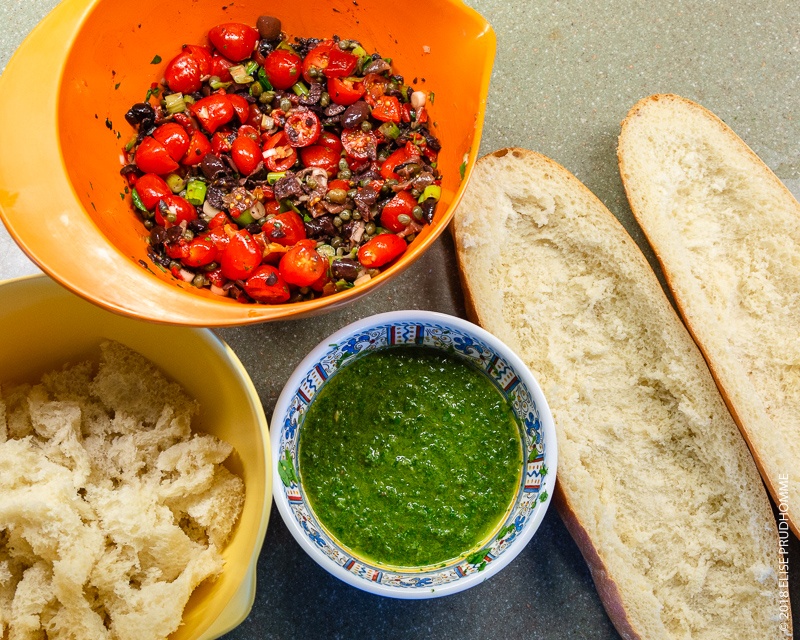
Recipe for making a Pan Bagnat sandwich

Ingredients for a Pan Bagnat sandwich

Version #1

Anchovy and Watercress Filling

1 cup chopped Kalamata olives
6 1/2 oz or roasted red peppers, drained, patted dry and chopped
4 scallions, minced
1 pint of cherry tomatoes, seeded and chopped
4 anchovies, rinsed, patted dry and chopped
3 T capers, drained
1/3 cup Italian parsley leaves, minced
1 cup watercress leaves
1/4 lb tuna steaks (Ahi or Albacore), seared and sliced
2 12-inch to 16-inch loaves of crusty bread (French, Italian or sourdough)

Dressing

1 cup packed fresh Italian parsley leaves
1/3 cup packed watercress leaves
1 garlic clove
3 T fresh lemon juice
4 anchovies, rinsed and patted dry

Preparation

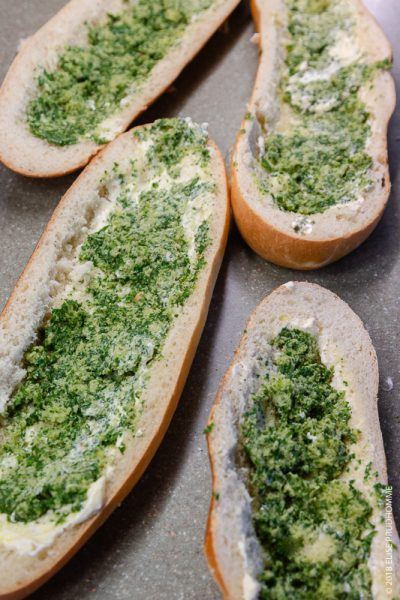
Slice the bread horizontally and hollow out the top and bottom leaving shells 1/2-inch thick.  Reserve 1 cup of packed bread crumbs from the loaf interior in a bowl. Place a large piece of plastic wrap in a baking sheet and place the shells on it.

Make the filling: Combine the olives, red peppers, scallions, tomatoes, anchovies, capers, parsley and watercress together in a bowl.

Make the dressing: Finely mince the parsley, watercress, garlic, reserved bread crumbs, lemon juice and anchovies in a food processor.  With the motor running, add oil in a steady stream and blend the dressing until emulsified.

Add 1/4 cup of the dressing to the filling and spread the remaining dressing on the inside of the bread shells.

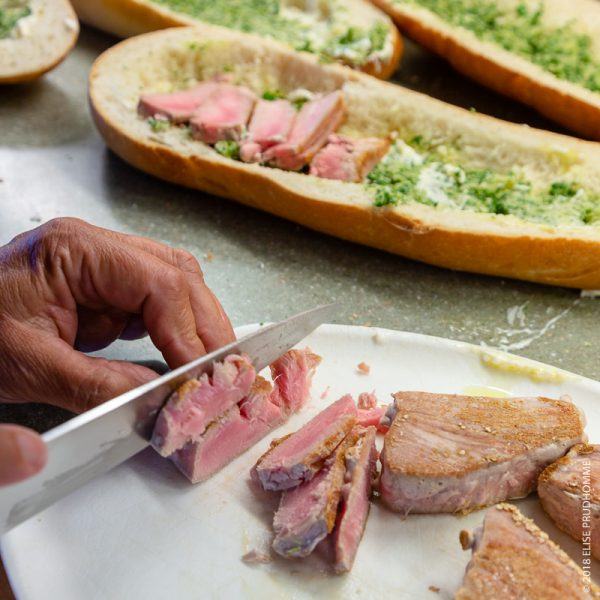
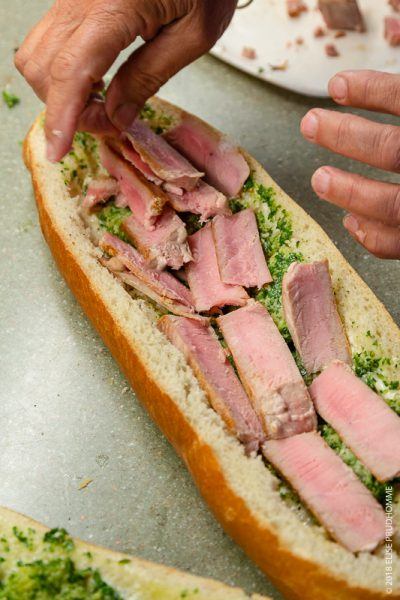
Top with the sliced tuna and then mound the filling in the shells, packing it down, and fit them together tightly.

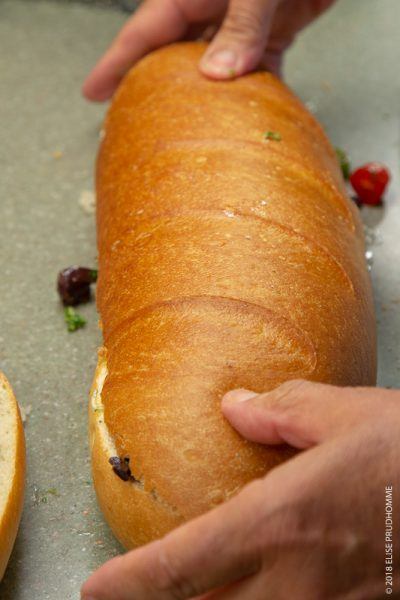
Press on the sandwich to pack down the filling then wrap the Pan Bagnat tightly in plastic wrap.  Place another baking sheet on top of the Pan Bagnat and add several 1-pound weights on top.  Chill for at least one hour. The Pan Bagnat may be made overnight and kept covered and chilled.

Serve the Pan Bagnat cut into 2-inch slices with a bottle of our Three Feathers Pinot Noir.

Recipe for making a Pan Bagnat sandwich

Closing the sandwich and pressing down before wrapping

Version #2

Goat Cheese and Tuna Filling

3 ounces of mild goat cheese (Montrachet for example)
1 cup of chopped Kalamata olives
1 cup of arugula leaves, rinsed and spun dry
3 large radishes, sliced
3 small tomatoes, sliced thin
1/4 lb tuna steaks (Ahi or Albacore), seared and sliced
8 large fresh basil leaves, shredded

Dressing

4 T olive oil
1 small garlic clove, minced
1 T balsamic vinegar
Salt and pepper to taste

Preparation

Slice the bread horizontally and hollow out the top and bottom leaving shells 1/2-inch thick. Place a large piece of plastic wrap in a baking sheet and place the shells on it. Brush the bottom shell with 1 tablespoon of the olive oil.

Blend the remaining 3 tablespoons of olive oil, balsamic vinegar, minced garlic clove and salt and pepper set aside.

Spread the goat cheese on the bottom shell and top with the olives, arugula and radishes. Drizzle the radishes with 1/3 of the dressing then top them with the tuna slices and another 1/3 of the dressing. Add the tomatoes and basil and drizzle with the remaining dressing.

Fit the top shell over the bottom one and wrap the Pan Bagnat tightly in plastic wrap. Place another baking sheet on top of the Pan Bagnat and add several 1-pound weights on top. Chill for at least one hour. The Pan Bagnat may be made overnight and kept covered and chilled.

Serve the Pan Bagnat cut into 2-inch slices with a bottle of our Three Feathers Pinot Noir.

Oregon Coast picnic with Pan Bagnat and Three Feathers Pinot Noi

Picnic pairing with Pan Bagnat and a bottle of 2016 Three Feathers Pinot Noir.

2018 Vineyard Grower’s Update

Elise StimacFamily, Growing, Vineyard, WildlifeLeave a Comment

Bloom on vines at Three Feathers Estate & Vineyard

2018 Vineyard Grower’s Update

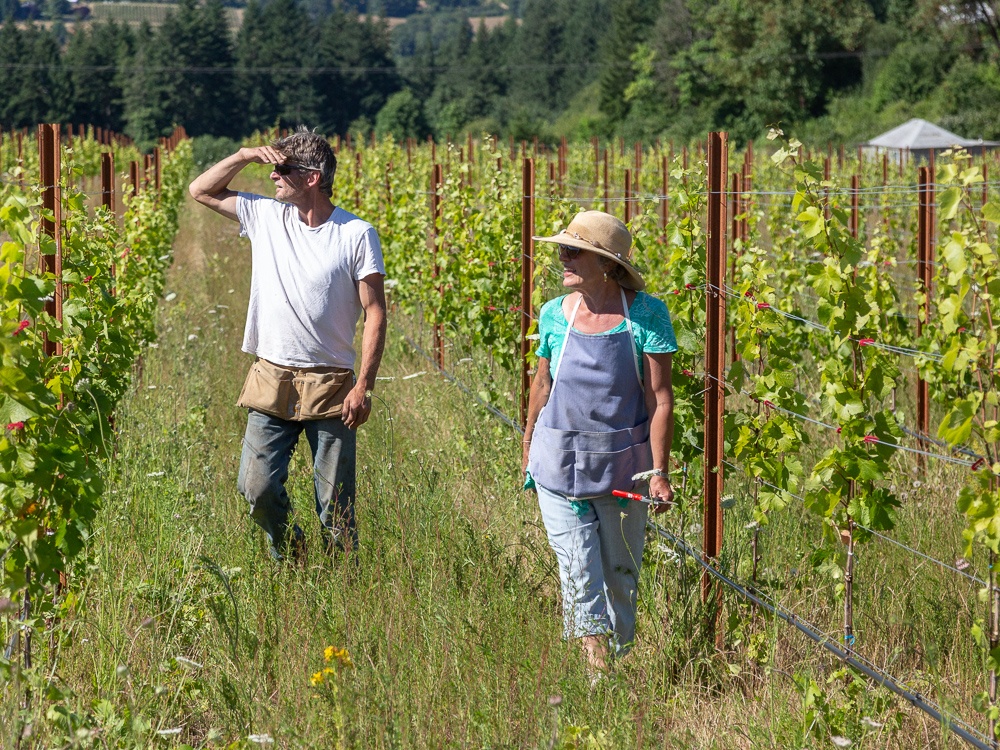
The 2018 season in the vineyard began with pruning in early February. The winter was cool and dry punctuated with rainy periods, but not characteristically wet.

Even spring was not very wet despite lingering cool temps and Bud Break was a month later than last year, on May 2. Once the plants started growing it was off to the races as we sought to keep the vines inside their trellis wire. Healthy vines require proper disease protection and nutrients so we sprayed organic products every 2 weeks; magnesium, boron, calcium, sulfur etc.

Pruning and training at Three Feathers Estate & Vineyard
Three Feathers team members prune and train vines for the next growth spurt.

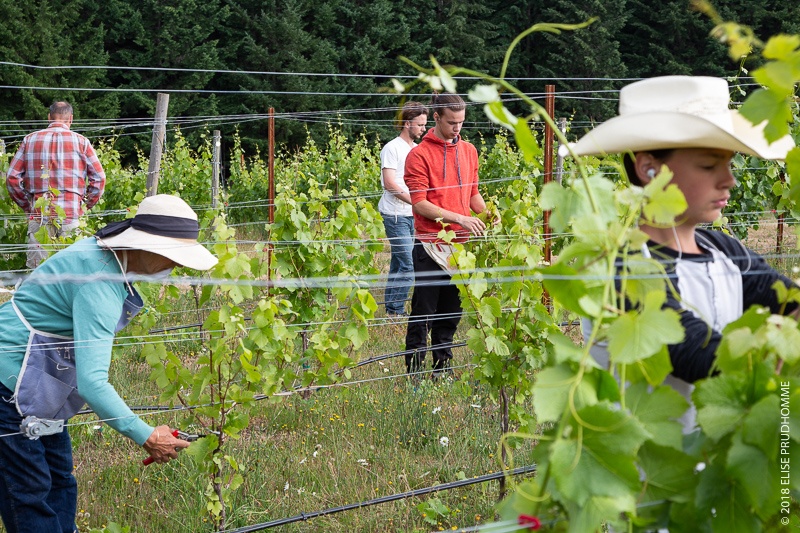
Our French crew arrived from Paris on June 22nd and immediately went to work pruning and tying vines. The result of all this labor is a continuing improvement in the balance and condition of the vines and an increase in fruit production.

Pruning and training at Three Feathers Estate & Vineyard
That’s a wrap! Christine and Scott watch a flying hawk after finishing the vinework for the summer months.

Our season continues to be dry and we do not expect rain anytime soon. Although the dry summers are normal for us this drought compounded with the winter dryness stresses the plants and our irrigation system. At our elevation of 800-1200 feet we enjoy cooler temps by 7-10 degrees which in these hot summer days benefits the cool loving Pinots.

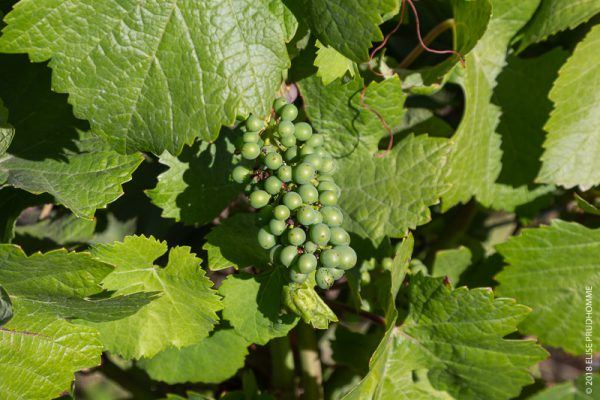
Pinot Noir grapes in early stage of maturity.
Pinot Noir grapes in the early stage of maturity.

As August approaches, the vines slow down and so do we while the vine’s energy is concentrated in the ripening clusters.  This year, birds have been a great topic of conversation in our family, with the discovery of several nests in the vines and the successful rescue mission of a hawk.

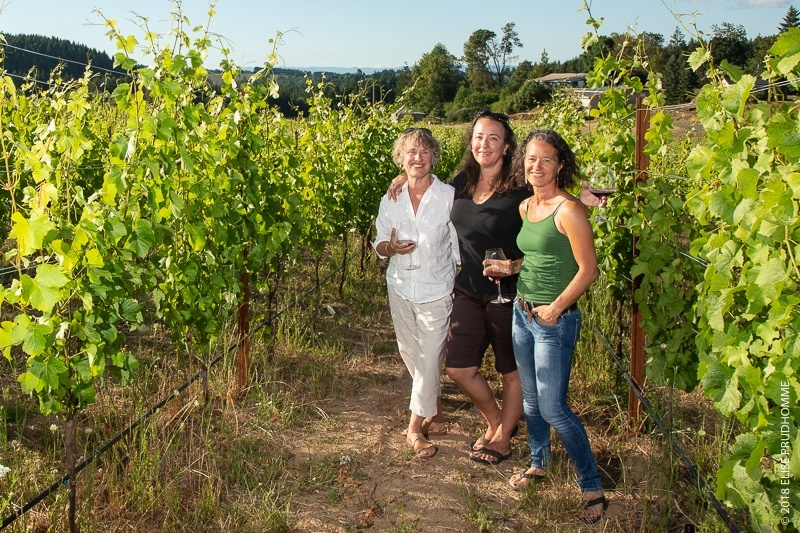
We take a breather, enjoying the gorgeous sunny days and family gathering for a photo shoot in the vines.

Three Feathers summer photoshoot in the vineyard.
Christine (left), Cynthia (middle) and Elise (right) pose for a summer photo shoot in Three Feathers vineyard.
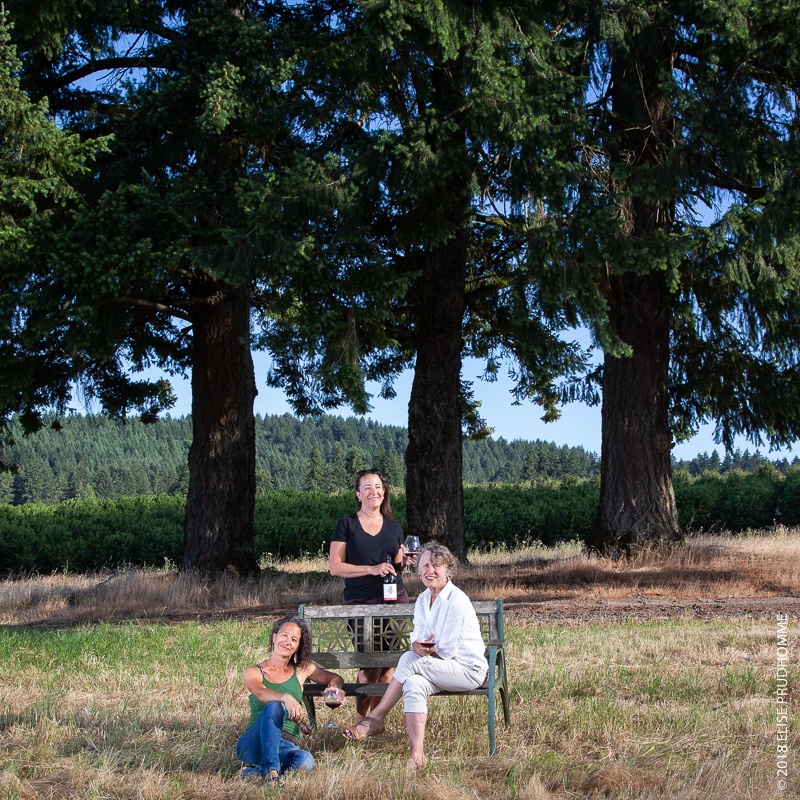
Three Feathers owners pose in front of three douglas fir trees.
Elise (left), Cynthia (middle) and Christine (right) pose in front of three Douglas Fir trees on Three Feathers Estate.

Simple Salmon with Sour Cream Herb Dressing and Fresh Berries

Elise StimacPairing, RecipesLeave a Comment

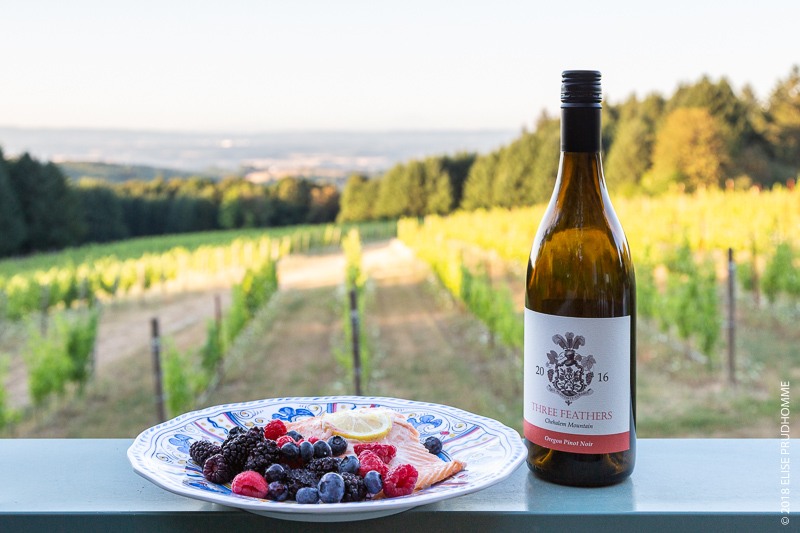
Simple Salmon with Oregon berries and our 2016 Three Feathers Pinot Noir.

Simple Salmon with Oregon berries and our 2016 Three Feathers Pi

Simple Salmon and Oregon berries with a bottle of 2016 Three Feathers Pinot Noir.
Simple Salmon with Sour Cream Herb Dressing and Oregon Berries

This recipe is inspired by the French salmon eaters in our family across the Atlantic, two of whom produce smoked salmon professionally and provide us with a steady source of delicious fish throughout the year.
This on-the-go recipe is a perfect summertime standby designed to feed any quantity of people with ultimate simplicity for a perfect result every time. Accompanied by Guess Again Carrots, a delicious recipe introduced to us by Virginia Roosevelt after whom our 2017 Cuvée Virginia is named, and a bottle of our 2016 Three Feathers Pinot Noir whose fruity aroma and juicy acidity pair perfectly with salmon.

Simple Salmon

Ingredients
1/2 lb per person of Atlantic salmon fillets with the skin on
Rock salt or Sel de Guerande

Preparation
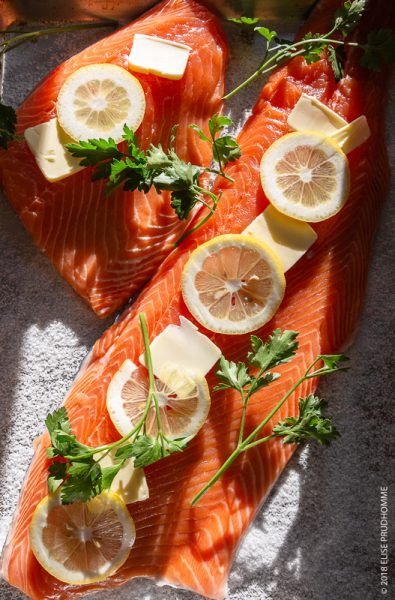
Layer a flat baking sheet with salt up to 1-inch thick. Place the salmon fillets on top, sink face down on the salt. Place lemon slices on the top and a few pats of butter (optional).

Bake in the oven at 350° for 30 minutes or until done.  Serve with a selection of fresh berries; blackberries, raspberries and blueberries and a dollop of Sour Cream Herb Dressing.

Simple Salmon recipe - pre-oven preparation

Atlantic salmon filet set on rock salt ready to go in the oven.

Sour Cream Herb Dressing

Ingredients
2 cups sour cream
1 large shallot, minced
1/2 bunch of your choice of parsley, cilantro, basil, or chives, minced
1 T olive oil
Salt and pepper to taste

Preparation
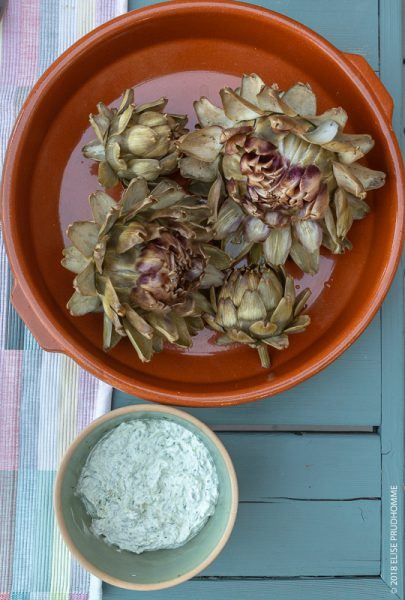
Mix the ingredients together and add salt and pepper to taste. If you have a small mixer, mince the shallots and herbs together first then and add sour cream, olive oil and seasoning.  Here we have added homegrown artichokes to the mix for a vegetable accompaniment.

Sour Cream Herb Dressing and Home-grown Artichokes

Sour Cream Herb dip and cooked home-grown artichokes

Guess Again Carrots

This recipe is an ideal accompaniment for many dishes, including salmon.

Ingredients
2 lbs of carrots, peeled and chopped into 1-inch chunks
1 medium onion or shallot, grated
2 cups of sharp cheddar cheese, grated
Salt & Pepper to taste

Preparation
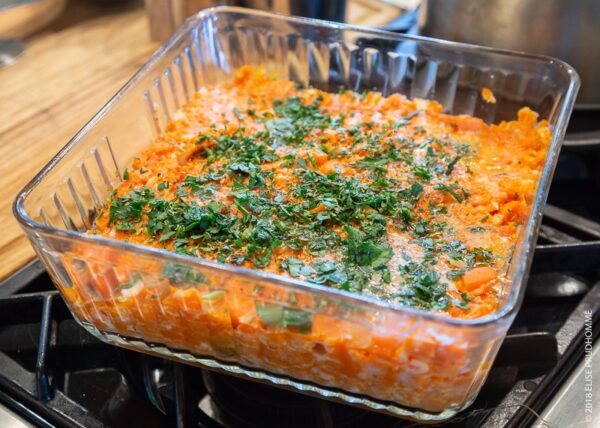
Boil the carrots until cooked through. Drain and mash with a potato masher. Mix the carrots, onion and cheese together with salt and pepper and put in a casserole or Pyrex dish. Sprinkle with parsley or breadcrumbs, or why not try a non-anchovy based gremolata (ground parsley, garlic & lemon zest).

Bake at 350° for about 40 minutes until it bubbles.

Guess Again Carrots sprinkled with a light gremolata

Guess Again Carrots topped with a non-anchovy gremolata.

Three Feathers Wines featured at Taste on 23rd

Elise StimacLocal Venues, Wine DistributionLeave a Comment

Façade of Taste on 23rd in Northwest Portland, Oregon. They are featuring Three Feathers wines.
Façade of Taste on 23rd in Northwest Portland, Oregon.

Three Feathers Wines featured at Taste on 23rd

We are pleased to announce that Three Feathers wines are now available at Taste on 23rd Wine Bar Bottle Shop located in the charming neighborhood of Northwest Portland. Customers can purchase our 2016 Three Feathers Pinot Noir by the bottle to have at home or with food served on site.

Three Feathers Uncorked

Elise StimacWine making

A horse wanders in a grove of cork trees in the valley of Ronda, Andalusia, Spain.

A horse wanders through a Cork Oak grove near Ronda, Spain.

A horse wanders through a Cork Oak grove near Ronda, Spain © Elise Prudhomme

Three Feathers Uncorked

To cork or not to cork?

Some people might wonder why we have chosen to cap our wine with screw caps instead of cork.  Most obviously, it is cheaper.

Real cork, which comes from the bark of the Cork Oak tree (Quercus suber), is grown in The Mediterranean. Although the tree does not die when the bark is harvested it is very slow to regenerate and therefore the price is high. Once harvested, the bark takes 12 years or more to regrow. With the growth in demand as wine sales increase worldwide, in the long run, natural cork is not sustainable. Plastic cork is not very biodegradable either.

The second issue with cork is that there is always a certain amount of oxygen that seeps into the wine through the cork. This creates the possibility of spoilage – or the wine becoming “corked”. The loss to the winemaker of spoiled wine is a big consideration when choosing how to seal the bottles.

Finally, although there is perhaps more romance when opening a bottle that has a cork, sommeliers, restaurant waitstaff, and those who are “cork challenged” appreciate the ease of the screw cap.

Picnickers carrying a bottle of our Three Feathers Pinot Noir will not have to panic mid-hike; “Did we remember to bring the cork screw?!”

Cork Oak tree grove planted near Ronda, Spain by Elise rudhomme

Cork Oak tree grove planted near Ronda, Spain © Elise Prudhomme