
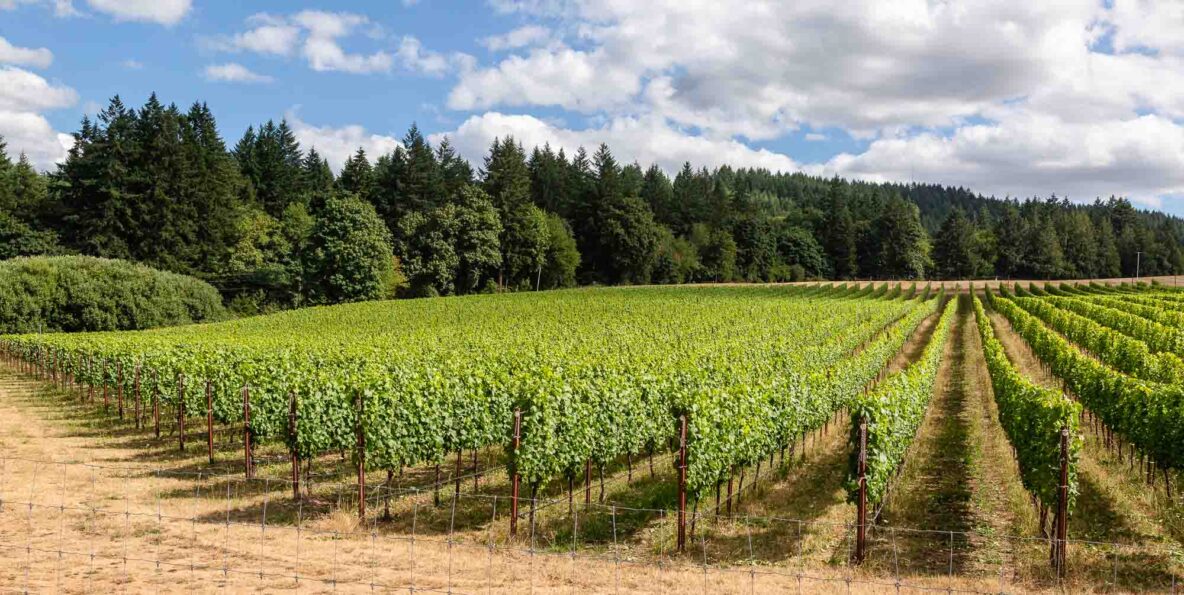

Our Vineyards – Growing Oregon Pinot Noir in The Willamette Valley
Our vineyards at Three Feathers Estate are situated in the heart of the Chehalem Mountains American Viticultural Area (AVA), at the highest and northern most corner of the Willamette Valley AVA, Oregon. We are about 60 miles (km) east of the Pacific Ocean and 25 miles (km) southwest of Portland, right along the 45th parallel.
Three Feathers Wines are sourced from two vineyard sites located between Hillsboro and Newberg, 8 miles northwest of Newberg and 1 mile from Bald Peak State Park (1,633 feet elevation), on Finnigan Hill Road.
Although our properties comprise rolling hills from 700-1000 feet in elevation, the hills form a natural heat sink – sheltering from winds blowing south through the Columbia Gorge and capturing summer warmth in its own natural micro-climate. Warm days and cool nights provide ideal conditions for growing Pinot Noir.
At this high-elevation there are challenges but also advantages. Temperatures are 7-10 degrees cooler than in the Valley. We are not subject to erratic frosts as are the vineyards at lower elevations. Grapes can be harvested for several different styles of wine; Pinot Noir, Pinot Gris, White Pinot Noir, Rose or even sparkling wines depending on the ripeness of the fruit.
Our Vineyards in the Laurelwood District – Chehalem Mountains AVA

Torio Vineyard
Acres: 5 acres (2 hectares)
Elevation: 1,140 feet (347 m)
Soils: Laurelwood
Aspect: west; northwest
Established: 2011
Vine Density: 1,100 vines/acre
Varietals: Pinot Noir
Clones: Pommard, Dijon 115, 828, 777, Précoce
First Vintage: 2017
Read More About Torio Vineyard


Three Feathers Vineyard
Acres: 10 acres (4 hectares)
Elevation: 800 feet (244 m)
Soils: Laurelwood
Aspect: north; northeast; southwest
Established: 2014
Vine Density: 1,150 vines/acre
Varietals: Pinot Noir, Pinot Gris
Clones: Dijon 667, 115; PG 152
First Vintage: 2016
Read More About Three Feathers Vineyard

Laurelwood District AVA – Three Feathers Terroir
Volcanic soils, marine sedimentary soils and a distinct series of loess called Laurelwood can all be found throughout the Chehalem Mountains AVA. This diversity of soils has spurred the creation of several sub-AVAs based on soil type, ours of which is the Laurelwood District AVA.
In fact, the creation of this particular bit of earth is very interesting.
Some Geological History
Chehalem Mountains is the creation of the Pleistocene Era that started 1.8 million years ago and ended roughly 12,000 years ago, although some accounts feel we are still in that era. This is the most recent of several Ice Ages. The underlying structure of the range is described by various accounts as the result of uplift or plate activity. Indeed, we are told that there is a seismic station on the mountain to register any seismic activity. In 1991 we experienced a minor earthquake.
During the Pleistocene Era, the Earth experienced large fluctuations in temperature. Glaciers expanded and contracted. Ellen Morris Bishops states in her book:
“For most of the 1 million years of the Pleistocene, an unremitting battle was fought between Cascade eruptions that sought to build a mountain range, and Cascade glaciers that worked to wear it down”.
– Ellen Morris Bishop, In Search of Ancient Oregon: A Geological and Natural History

Missoula Floods
During this period, there were frequent tremendous unimaginable floods that were created by either lava or ice damming in the region. Millions of tons of mud, gravel and boulders were washed into the area from the north – called the Missoula Floods as some of them originated as far away as Montana.
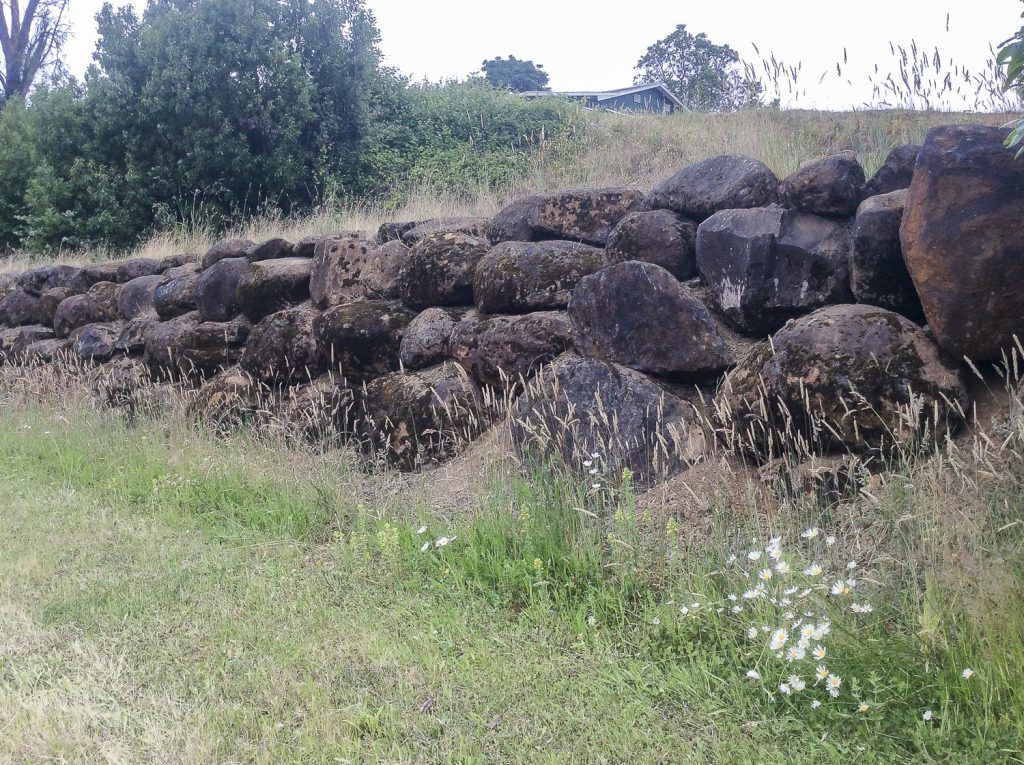
Underlying our soil at Three Feathers are massive basalt boulders worn round by flooding. You can see these boulders were used to create the retaining wall at our barn. Some boulders were too big to move and are found on the property. Regionally called “dirty basalt” these rocks are reddish from the iron ore found in them.
Loess
On top of the boulders is layered our Laurelwood soil. Described by Pinot File as: …silty, nearly ashy, rock flour deposited on the mountains from powerful winds from the surrounding landscape during the last Ice Age…… This type of soil is called Loess – or windblown. This red soil is high in iron and very acidic.
Naturally as the particles are fine enough to be blown it is extremely delicate. The six to ten feet of Loess soil at Three Feathers is designated “highly erodible” so we much be careful not to overwork it. It also lacks humus or organic material that characterizes soil that has had long periods of vegetation on it. If left alone, Douglas Fir trees sprout like weeds – as close as 6 inches apart. To sweeten the soil, we add ground limestone to help the vines absorb nutrients.

All of these factors contribute to the unique production that are Three Feathers grapes and wine. The combination of the soils, the aspect of the vineyard and the individual grape clones contribute to the mineral and spice flavors in our wines. As we say on our bottles: “Terroir – What Defines Us”.
Our Vineyards & The Season – A Winegrower’s Story
At Three Feathers, there is an element of kismet in our decision making process. Every vintage is different and we are not completely in control. This is the way wine making has always been and good wine making will continue to be. Three Feathers will keep on exploring possibilities and try to make the best wine the vines will give us.
Wine in the Making Photo Gallery


